Overview
Plants under drought and plants fighting off a bacterial infection both flood their tissues with reactive oxygen species (ROS) — the same molecules, used for two different jobs. That overlap raises a practical question for anyone breeding rice: if a plant has already been through a drought, is it better prepared for a pathogen because its ROS-scavenging machinery is already switched on, or worse off because it has burned through its antioxidant reserves? I ran a greenhouse experiment at the University of Agricultural Sciences, Bangalore to test this directly — 36 rice plants across two genotypes with known high and low acquired tolerance, three drought regimes, and a Xanthomonas oryzae inoculation, tracking membrane damage, lipid peroxidation, and chlorophyll loss over twelve days. The answer turned out to depend on how the drought arrived: a slow, incremental drought primed the plants and measurably reduced infection damage, while an abrupt drought of the same final severity did the opposite. The effect was strongest in the high-tolerance genotype, which points toward breeding rice varieties resistant to water scarcity and bacterial blight at the same time.
Context
Rice feeds more than half the world, and it is squeezed from two directions at once. Drought is intensifying with climate change in exactly the regions where rice is grown, and bacterial blight — caused by Xanthomonas oryzae pv. oryzae (Xoo) — occurs in epidemic proportions worldwide. These are usually studied as separate problems, but in a real field they arrive together, and the plant handles both through partly shared machinery.
Reactive oxygen species sit at the center of that overlap. Under drought, ROS accumulate in guard cells as a stomatal-closure signal, and excess ROS peroxidize thylakoid membrane lipids and degrade photosystems. Under Xoo attack, ROS are generated deliberately at the plasma membrane by NADPH oxidases — H₂O₂ cross-links lignin to reinforce cell walls, and local concentrations above ~10 μM trigger the hypersensitive response, killing neighbouring cells to wall off the pathogen. The same molecule is a weapon in one context and collateral damage in the other, and the plant's antioxidant system (SOD, CAT, APX, glutathione reductase, ascorbate) has to arbitrate between them.
There is also a practical motive for getting this right. Xoo strains have already evolved resistance to streptomycin, an antibiotic that matters in human tuberculosis treatment. Breeding for a plant's own ROS-management capacity is a way to reduce reliance on chemical antimicrobials rather than accelerate resistance in them.
Question
Does prior drought stress prime rice against Xanthomonas oryzae infection or compromise its defence — and does the answer depend on how gradually the drought is imposed and on the genotype's acquired tolerance trait (ATT)?
Method
Genotypes and experimental design. Two Oryza sativa genotypes with contrasting acquired tolerance traits were used: AC 39000 (high ATT) and BPT 5204 (low ATT), 18 plants each. Soil was oven-dried at 45 °C for 48 hours to establish a bone-dry baseline, and field capacity (FC) was computed gravimetrically as the ratio of saturated to oven-dried soil weight. 36 cups were filled with ~190 g of dry soil, three seeds per cup, all initially watered to 100% FC for germination. Each genotype was then split across three drought treatments with six replicates each — control (held at 100% FC), gradual drought (FC reduced 5% per day over 10 days down to 50%), and rapid drought (immediate drop to 50% FC, maintained by periodic weighing) — followed by a 10-day recovery back at 100% FC. Crossing genotype × drought regime × bacterial exposure produced twelve labelled treatment groups.
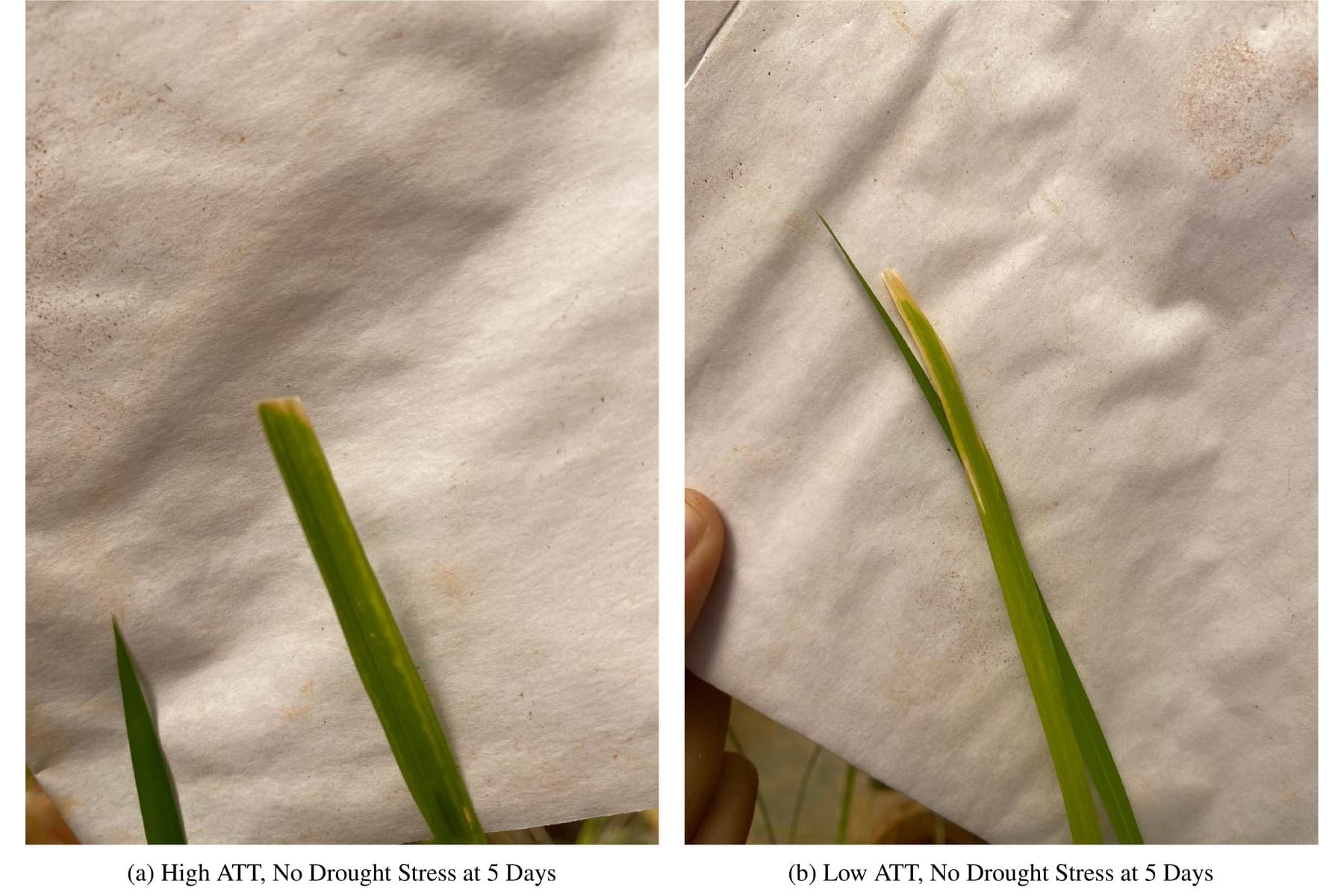
Pathogen challenge. X. oryzae stock held at −80 °C was revived on kanamycin-amended agar by spread plate, incubated five days at 32 °C, then transferred to nutrient broth and shaken at 150 RPM at 32 °C for two days until optical density at 600 nm reached 0.6–1.0. Inoculation used a uniform mechanical wound: sterilised scissors dipped in the bacterial suspension were used to make a 2 cm cut on one leaf per seedling — matching how Xoo naturally enters through hydathodes and leaf wounds before colonising the xylem. Plants were then held in an airtight greenhouse at 28 °C.
ROS and damage quantification. Three orthogonal readouts were measured on days 1, 5, and 12 so that the trajectory, not just the endpoint, was visible:
- Evans Blue staining for membrane integrity and cell death — the dye is negatively charged and cannot cross an intact membrane, so uptake is a direct proxy for ROS-induced membrane permeabilisation. Leaf samples were stained in 0.25 g Evans Blue in 0.1 M CaCl₂ (pH 5.6) for one hour, rinsed, treated with 1% SDS, centrifuged at 12,000 RPM for 15 minutes, and read at 600 nm.
- TBARS assay for lipid peroxidation, quantifying malondialdehyde (MDA), the breakdown product of peroxidised polyunsaturated fatty acids. 2 cm leaf samples were ice-quenched and stored at −80 °C, MDA extracted in 5% TCA, then reacted with 0.5% TBA in 20% TCA at 95 °C for 30 minutes and read at 532 and 600 nm.
- Chlorophyll content as an integrative measure of photosynthetic health, extracted by submerging 2 cm leaf samples in DMSO for 24 hours and computing chlorophyll a and b from absorbance at 645 and 663 nm using the Arnon equations.
Analysis. Group means were compared across genotype, drought regime, and infection status; paired t-tests were used to test the gradual-versus-abrupt contrast; and Pearson correlation coefficients were computed between each measurement and time, per treatment group, to compare how steeply each group was deteriorating rather than only where it ended up.
Result
Gradual drought reduced infection damage; abrupt drought increased it. On day 12, Evans Blue uptake in infected plants was lowest in the gradually stressed group at 848.5 ng, against 971 ng in the well-watered control and 1053 ng under rapid drought. Same final water deficit, opposite outcome — the trajectory of the stress mattered more than its magnitude, which is what a priming effect looks like. The paired t-test on this contrast returned p = 0.0005.
The high-tolerance genotype held membrane integrity almost flat under gradual drought. High-ATT plants under gradual drought recorded Evans Blue values of 268.0, 273.0, and 266.0 ng across days 1, 5, and 12 — essentially no accumulating damage over the full time course. The same genotype under rapid drought rose from 336.5 to 751.5 to 848.5 ng. Low-ATT plants under rapid drought fared worst, climbing from 349.0 ng on day 1 to 975.0 ng by day 12.
Chlorophyll retention followed the same split. High-ATT plants began with more chlorophyll (1.667 vs 1.276 mg·g⁻¹ FW) and lost it more slowly: by day 5 the gradually stressed high-ATT plants had dropped only to 1.569 mg·g⁻¹ FW, versus 1.307 under rapid drought. By day 12 the low-ATT rapid-drought group had fallen to 0.966 mg·g⁻¹ FW while high-ATT plants under comparable stress held 1.212. Across the tolerance contrast, retention was significantly higher in high-ATT plants (1.166 vs 0.966 mg·g⁻¹ FW, p = 0.0005). Shoot length showed the same ordering — 52.6 cm average for high ATT against 46.8 cm for low ATT, with the gap widening under rapid drought.
Lipid peroxidation confirmed it independently. MDA content was lowest in the gradually stressed low-ATT infected group (0.088 nmol·mg⁻¹ on day 12) relative to both its rapid-stress and control counterparts — so the priming benefit was not confined to the tolerant genotype, even though it was strongest there.
Correlation structure. Per-group Pearson coefficients against time were strongly negative for chlorophyll (−0.940 to −0.992) and strongly positive for Evans Blue (0.850–0.877) and TBARS (0.972–1.000) across every infected group — infection reliably degrades all three. The informative detail is that the correlation was least steep in the gradually stressed high-ATT group (r = −0.940 for chlorophyll) compared with its own well-watered control (r = −0.992): the primed plants were not merely less damaged at the end, they were deteriorating more slowly throughout.
Taken together, the results support an ROS-scavenging priming mechanism — moderate, incremental drought upregulates antioxidant enzymes such as SOD and CAT, leaving the plant with capacity in reserve when the pathogen's oxidative burst arrives. Abrupt stress disrupts cellular homeostasis before those adaptive responses can be mounted, so protein denaturation, membrane peroxidation, and chlorophyll degradation compound instead.
Reflection
The result I did not expect going in was that the rate of an abiotic stress mattered more than its severity. Both drought treatments ended at the same 50% field capacity; only the ones that got there slowly gained anything from it. That is a reminder that stress physiology is not a dose-response curve — it is a race between damage and the plant's ability to mount an adaptive response, and how fast you apply the stress decides who wins.
It also changed how I read the breeding literature. Drought tolerance and disease resistance are usually treated as separate traits to select for, but if ROS-scavenging capacity underlies both, a genotype like AC 39000 is not two wins — it is one mechanism paying off twice. That is the more useful framing for varieties that will have to face water scarcity and bacterial blight in the same season.